
The Density Revolution
For centuries, humanity optimized parts while remaining blind to systems.

We built departments instead of ecosystems.
Metrics instead of coherence.
Specialization instead of integration.
We became extraordinarily advanced at measuring isolated variables while remaining dangerously primitive at understanding how everything connects.
But a new revolution is beginning to emerge beneath technology, leadership, organizational science, and human behavior.
Not an industrial revolution.
Not merely an AI revolution.
A Density Revolution.
For the first time in human history, we are developing the ability to map the invisible architecture between people, organizations, incentives, trauma, communication, leadership, and institutional momentum at scale.
AI is not simply making systems faster.
It is making systems visible.
And once systems become visible, everything changes.
Part 1: The Real Problem Was Never Intelligence
Most organizations do not fail because they lack talent, capital, or information.
They fail because they lack coherence.
Information exists, but it does not flow.
Leadership exists, but it cannot see invisible friction.
Teams exist, but incentives remain fragmented.
Culture exists, but nobody can accurately measure the hidden emotional architecture shaping behavior beneath the surface.
The result is what most institutions mistakenly normalize:
Burnout.
Political infighting.
Operational drag.
Communication bottlenecks.
Leadership fatigue.
Shadow hierarchies.
Institutional paralysis.
Most organizations attempt to solve these problems linearly.
More dashboards.
More software.
More reporting.
More meetings.
More restructuring.
But the issue is rarely isolated.
The issue is systemic fragmentation.
This becomes obvious once you begin understanding density.
Part 2: What Density Actually Means
Density is the degree to which meaningful connections inside a system become visible, aligned, and mutually reinforcing.
High-density systems compound momentum.
Low-density systems leak momentum.
This density exists across four major dimensions:
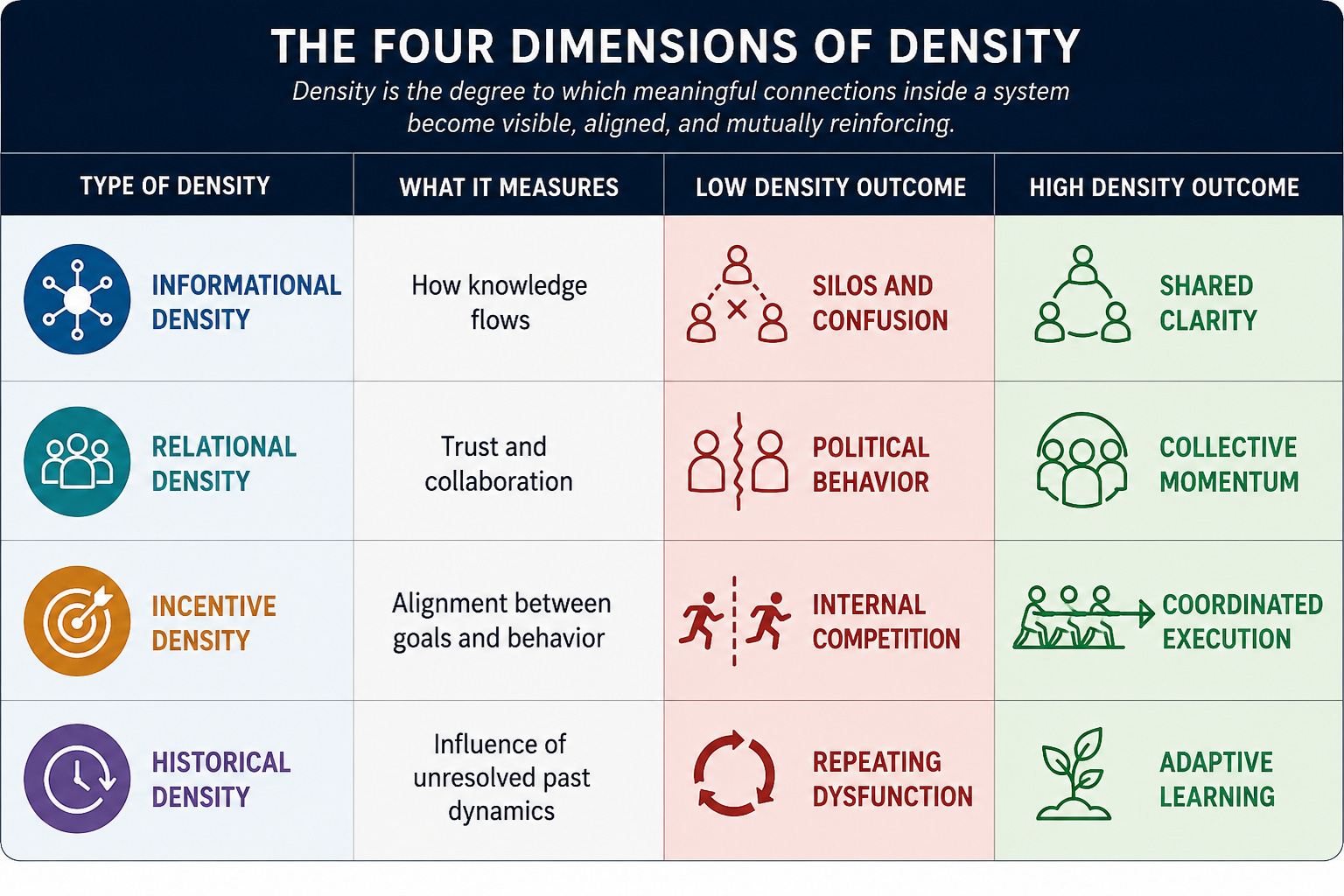
Most organizations only measure the first category.
Almost none measure the others effectively.
But increasingly, AI systems are beginning to surface these hidden dimensions indirectly through network analysis, communication mapping, sentiment analysis, workflow modeling, and behavioral pattern recognition.
And that changes the game entirely.
Part 3: The Emergence of Invisible System Mapping
This is no longer speculative.
It is already happening.
Humanyze, an organizational analytics company, uses AI-driven organizational network analysis to map communication density inside enterprises. Their systems identify collaboration bottlenecks, isolated teams, and hidden operational influencers that traditional org charts completely miss.
TrustSphere analyzes communication metadata to surface informal influence structures inside organizations. In many cases, the people driving operational momentum are not the people holding formal authority.
Microsoft Viva and Workplace Analytics already perform primitive forms of organizational consciousness mapping by identifying collaboration overload, meeting saturation, burnout indicators, and disconnected teams.
Several healthcare systems are experimenting with predictive burnout analytics by combining workflow density, scheduling pressure, sentiment analysis, and communication load to identify physician exhaustion before retention collapse occurs.
In cybersecurity, organizations increasingly recognize that the greatest vulnerability is not infrastructure.
It is human behavior.
Threat analysis is expanding beyond servers and endpoints into relational trust patterns, communication mapping, and behavioral exposure analysis because social engineering exploits human systems more effectively than technical systems.
The world is becoming network aware.
And as systems become more visible, something extraordinary begins to emerge.
What AI is discovering computationally, systemic methodologies have often sensed experientially for decades.
Part 4: The Bridge Between AI and Systemic Constellations
Systemic constellations operate from a deceptively simple premise:
Human beings are not isolated individuals.
They are expressions of interconnected systems.
Family systems.
Organizational systems.
Cultural systems.
Historical systems.
Within those systems exist hidden loyalties, unresolved fractures, unconscious compensations, inherited behavioral patterns, exclusions, and emotional entanglements that quietly shape present reality.
Most organizations intuitively know this already.
They simply lack language for it.
Why do leadership teams repeatedly sabotage themselves despite extraordinary talent?
Why do mergers fail despite strategic logic?
Why do institutions unconsciously recreate the same crises over and over again?
Why do high performers burn out while dysfunctional dynamics survive?
Because beneath every visible structure exists invisible architecture.
Systemic constellations attempt to surface this architecture experientially through human relational awareness.
AI now has the potential to surface portions of it computationally through pattern recognition and network intelligence.
And when these worlds begin converging, a new form of leadership emerges.
Human intuition meets machine scale.
This is where the Density Revolution becomes far bigger than organizational consulting.
It becomes civilizational.
Throughout history, major breakthroughs often began with new forms of visibility.
The microscope revealed invisible biology.
The telescope revealed an invisible cosmos.
The internet revealed invisible information.
AI driven systemic mapping may reveal invisible human interconnectedness.
That possibility changes everything.
Part 5: The Momentum Advantage of Dense Systems
The highest performing systems of the future may not necessarily be the largest.
They may be the densest.
The most connected.
The most coherent.
The least internally fragmented.
Dense systems compound momentum.
One aligned executive team can transform an organization.
One coherent healthcare system can dramatically reduce burnout spread.
One integrated institution can outperform larger but fragmented competitors.
One healed family system can alter generations.
Momentum itself is systemic.
This creates a completely new competitive landscape.
The next great advantage will not simply be access to information.
It will be coherence.
Organizations capable of integrating informational, relational, incentive, and historical awareness into decision making will operate with enormous momentum advantages over institutions still trapped in fragmented thinking.
But this is where the conversation becomes uncomfortable.
Because visibility threatens illusion.
Part 6: The Risks, Resistance, and Ethical Fault Lines
The same technologies capable of revealing hidden organizational fractures could also become the most invasive surveillance architecture in human history.
Emotional mapping can become manipulation.
Behavioral analysis can become coercion.
Relational visibility can reinforce existing power structures rather than liberate organizations from them.
A system capable of identifying vulnerability can heal.
It can also exploit.
This matters because AI still has profound limitations.
AI can identify patterns.
It can map communication structures.
It can surface correlations and behavioral density.
But it still struggles to understand meaning.
It cannot fully comprehend unconscious loyalty, inherited shame, symbolic dynamics, existential fear, or the deeper phenomenological dimensions that systemic constellation work often surfaces experientially.
Human systems are not spreadsheets.
Reducing people into pure algorithmic outputs risks creating technologically sophisticated dehumanization disguised as optimization.
And there is another uncomfortable truth:
Many institutions will resist this revolution precisely because it reveals too much.
Systems survive through hidden agreements.
Hidden resentment.
Hidden dependency.
Hidden incompetence.
Hidden hierarchy.
Hidden trauma.
Visibility creates accountability.
And accountability is terrifying to systems built on unconscious compensation.
This is why widespread adoption will not happen next quarter.
This is likely a 5 to 10 year transition before systemic mapping reshapes institutions at scale.
But the early signals are already unmistakable.
The future is moving toward coherence, whether institutions are emotionally prepared for it or not.
Part 7: The Hopeful Future
Despite the risks, the implications are profoundly hopeful.
Because deeper visibility creates the possibility for deeper responsibility.
When organizations begin seeing how much dysfunction emerges from fragmentation rather than individual failure, blame starts losing its grip.
Curiosity replaces condemnation.
Understanding replaces projection.
Alignment replaces political survival.
Not perfection.
Not utopia.
Coherence.
And coherence changes everything.
For centuries, humanity optimized isolated parts while remaining blind to the whole.
The Density Revolution begins the moment we realize the system itself was always the real intelligence.
The organizations, governments, and communities that learn to see themselves clearly enough to stop fighting their own momentum will define the next era of human development.
Because the next great competitive advantage will not be information.
It will be coherence.